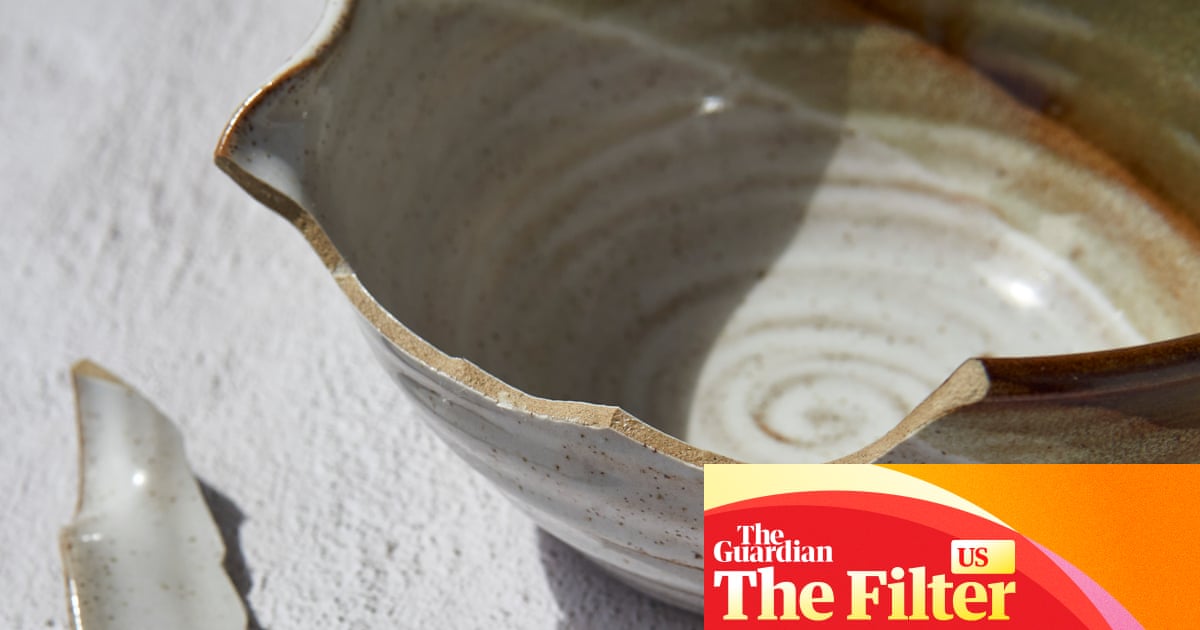
In the US, a broken cup goes in the trash. A ripped shirt gets donated or discarded. Damaged objects are useless, disposable.
But in Japan, a different worldview has taken root. “Choosing to repair is not simply sustainable, it is philosophical,” says Atsushi Futatsuya, a sashiko practitioner who mends clothing using bold, visible patterns. “It is a decision to remain in relationship with objects, even after they show signs of wear, when many would consider them to have reached the end of their usefulness.”
Repair can be artful, imperfection beautiful. Things we own can accumulate their own history, becoming more treasured with every chip and scratch, rather than losing value.
I first encountered this perspective when I was reviewing sustainable gift ideas and dabbled with a kintsugi kit, learning to fix broken ceramics using urushi resin and gold dust. My results are … a work in progress, but as someone who spends most of his time in front of a screen, it felt satisfying to craft something with heft and permanence.
So I kept learning, and sought out other Japanese crafts that don’t teach you to hide damage, but to honor it. I spoke with expert practitioners, and found kits that offer an accessible entry point, making it possible to try these techniques at home.
Dig out those old jeans and give these a try. You won’t master them in a weekend, but that’s kind of the point.
Kintsugi: the art of golden joinery
When a ceramic bowl breaks in Japan, it might be sent to a kintsugi artisan, who will mend the hairline fractures with urushi lacquer dusted with gold powder – the name literally translates to “art of golden joinery.”
The result doesn’t hide the break. It illuminates and celebrates it, the gold seams a recognition of its continued life. The philosophy connects to wabi-sabi, a Japanese aesthetic that finds beauty in imperfection and impermanence.
It’s a slow process that involves blending the urushi lacquer and applying it to the broken edges. After letting it cure for several days in a temperature- and humidity-controlled environment, you sand off the excess, and repeat until the object is crisscrossed with a web of dark lines. Finally, you sprinkle the gold dust over the slightly sticky urushi and polish it up.
“Traditional kintsugi did not originally include ideas about ‘reducing waste’ or sustainability,” says Kensuke Ikuta of Chimahaga, a kintsugi artisan. The materials are expensive and skilled labor required meant it was reserved for valuable heirlooms. “It is precisely because modern society now has more time and resources that this technique, which was once limited to very special objects, can now be connected with contemporary ideas of sustainability and used in that way.”
Getting started: Ikuta recommends beginners start with minimally damaged pieces – a chip here, a smooth break there – rather than ambitious multi-fragment repairs. The most common mistake? Underestimating curing conditions. “Urushi needs moisture in the air to cure, so the piece has to be kept in a container with sufficiently high humidity,” he advises. Temperature matters too: Ikuta suggests keeping the drying area warmer than 68F (ideally 74F or higher) for at least two days.
Starter kit: The Chimahaga standard kintsugi kit ($185) includes traditional urushi lacquer, gold powder and complete materials for ceramic repair. Another option is a kit from Hiramigakihou, which costs a little over $100 (16,500¥).
Chimahaga standard kintsugi kit
Hiramigakihou kit
Sashiko: stitches that strengthen
Sashiko translates literally to “little stabs”, a form of Japanese hand-stitching originally used to reinforce older, worn fabrics to extend their usefulness.
To start, mark out geometric patterns on the fabric, then use a simple running stitch– needle in, needle out – to sew through all fabric layers in one go, with the visible stitches on top creating the pattern.
“Sashiko quietly resists a culture that equates newness with worth,” says Futatsuya, author of the forthcoming book Sashiko: The Untold Story. Rather than discarding worn items, says Futatsuya, sashiko urges further commitment to them by adding stitches that strengthen the fabric using striking geometric patterns.
The beauty that results is incidental to the purpose, which is preservation. “When something is repaired, time is acknowledged,” he writes. “Someone noticed wear, paused, and responded. Through that act, the object gains depth rather than losing value. Use becomes part of its meaning, not a flaw.”
Getting started: The best approach, Futatsuya writes, is counterintuitive: reinforce before damage occurs by adding simple running stitches to vulnerable areas like knees and elbows. You’re preventing future tears, not just mending existing ones.
The most common beginner mistake is treating sashiko as purely decorative or treating it “as an aesthetic rather than an ethic”, Futatsuya writes. “Sashiko was never meant to perform creativity or artistry. It existed to support daily life.”
Beginners often assume rigid rules exist, Futatsuya notes, “when historically the craft was flexible and circumstance-dependent”. There is no wrong way to reinforce a garment.
Starter kit: In addition to Futatsuya’s book, available in May 2026, a good starter kit is the sashiko starter package ($67.90) from Sashiko Story. It includes fabric, mylar paper for transferring patterns, numerous types of thread, and the various tools and threaders you might need.
For less of a financial commitment, this Olympus sashiko sampler ($13.99) is produced in Japan by one of the oldest sashiko supply manufacturers and focuses on traditional asanoha motifs.
Sashiko starter package
Olympus sashiko sampler
Boro: the beauty of accumulated repair
If sashiko is a technique, boro is its outcome. Boro describes textiles that have been repeatedly patched and repaired throughout their lifespan, and is the result of years of accumulated layers of fabric and stitching until they become something new entirely. The blue jeans of Theseus, if you will.
“Boro is not a technique or a style, but one possible outcome of repetitive sashiko – appearing toward the end of a fabric’s life cycle, after years of use, care and repair,” Futatsuya writes. Historical boro textiles were born of necessity, not aesthetic decisions. Families in rural Japan, particularly in the colder northern regions, couldn’t afford to discard worn fabric, so, instead, they patched and reinforced garments across generations, creating layered textiles that recorded their family’s history.
This fabric was from a grandfather’s work clothes; this stitching was added during a harsh winter. The cloth becomes a record of the family that maintained it.
“Instead of asking, ‘How should this look?’ the question becomes, ‘How can this continue?’” Fatatsuya writes. “That change in intention is often more important than technique itself.”
In recent years, boro has found new appreciation as more people pursue slower and sustainable fashion. The layers of indigo fabric, visible white stitching, patches that don’t quite match have influenced contemporary designers. But authentic boro emerges organically from necessity, not design.
Getting started: Begin by patching worn garments with fabric scraps and simple running stitches (sashiko technique works well here). Let function guide form. The goal isn’t to create something Instagram-worthy on your first attempt (or at all). The goal is to extend the life of something you already own and respect the role it played in your and your family’s life.
Starter kit: The Yesterday Store Boro Mending Kit ($29) includes 14 pieces of Japanese fabric patches, two sashiko needles, and an instruction sheet. For a combined sashiko–boro approach, the Socorro Society Visible Mending Kit ($67) includes patterns, thread, needles, and tools for getting started.
Yesterday Store Boro Mending Kit
Socorro Society Visible Mending Kit
Kumiko: for want of a nail
Kumiko focuses more on building than on mending: artists create intricate geometric patterns from thin, precisely-fitted bars of wood – no nails or glue required. But the tiny size of the pieces means that old wood can often find a new life. Nick Mokey, the Filter editor, used 100-year-old Doug Fir scraps, too small for anything but the fireplace, to make kumiko for a friend’s wedding gift.
It’s a versatile medium. “I had a master once who said that, with wood, all mistakes can be repaired,” says David Gootnick, a kumiko practitioner who formerly restored old master Italian and German cellos. That principle, that any error can be fixed, shapes how he approaches the craft. “It can be jarring and disappointing to make a significant mistake,” he said in an email. “I try to take a mistake as an opportunity to stop, reflect on what happened, keep calm and make a plan about how to move forward.”
Kumiko dates to Japan’s Asuka period (6th–7th century), but most modern designs date from the Edo era (1603-1868), and are meant to mimic a natural pattern to bring good luck. The patterns not only look pleasing, but also distribute light and wind to promote calm and beauty.
Gootnick emphasizes the need to know your materials intimately. “It’s gratifying to know the characteristics of wood you are working with – the species but also the actual, unique piece of wood itself – knowing the wood well enough that you have an instinct as to how to repair a problem.”
Getting started: Des King, a kumiko craftsman in Australia, offers some of the best English-language tutorials on YouTube. “You’ll need a marking knife, a marking gauge, an accurate square, a pencil, and a piece of kumiko around about a quarter of an inch thick,” he recommends in one introductory video. Starter kits can ease the learning curve by providing pre-cut materials and angle jigs. Kumiko also requires some specialized tools, such as Japanese pull saws and low-angle planes, but they’re less expensive and intimidating than power tools.
Starter kit: The Lee Valley Kumiko Starter Kit ($14.50) contains accurately dimensioned basswood bars to create a seven and three-quarter inch square panel in a traditional hemp-leaf design. The project requires minimal tools but introduces fundamental skills. For a more comprehensive option, JT Woodworks Kumiko Starter Kits ($145) include pattern-specific jigs and detailed instructions.
Lee Valley Kumiko Starter Kit
JT Woodworks Kumiko Starter Kit
Reuse as art
These four crafts challenge modern consumption habits. They ask us to slow down, see value in what we already own and develop skills rather than simply purchasing solutions.
None of them promise quick results. Kintsugi requires patience while lacquer cures. Sashiko demands meditative attention to each stitch. Boro accumulates meaning only over time. Kumiko rewards precision that can’t be rushed.
Gootnick, who describes himself as “not a particularly patient person in life generally”, nonetheless finds peace in his woodworking shop. “I am surprisingly really patient and can keep a strong focus,” he says. “I find it easy to be grateful for my shop.”
In a world of disposable everything, these practices remind us that a different relationship with objects is possible, where imperfection isn’t something to hide, but something to honor.
-
Christopher Allbritton is a journalist, editor and media strategist based in Washington DC. He has covered technology and international affairs for more than two decades. A committed DIY tinkerer, he draws on personal experience for his writing on accessible technology, repair culture and sustainable living